Drive any road out of Asheville, up toward Weaverville, out US-19 into Maggie Valley or down past Flat Rock, and you will see metal roofs on cabins, farmhouses and new builds alike. There is a reason for that. Mountain homes sit under heavy tree canopy, take wind on the ridgelines, see snow and ice every winter at elevation, and often have steep pitches that are hard and expensive to re-shingle every couple of decades. Metal answers all of that with one roof that lasts a long time.
Arolite Group installs standing-seam and exposed-fastener metal roofs across Buncombe, Haywood and Henderson counties, Western North Carolina and Upstate South Carolina. We also install architectural shingle, which matters: when an exterior consultant inspects your roof, there is no incentive to steer you to one material or the other. We price both on your own house, in person, and explain which one fits the pitch, the trees, the budget and how long you plan to stay.
This page covers the two main metal systems, why metal suits this part of North Carolina, how the deck is prepared before a panel goes on, how colors and profiles are chosen, and the question we get most often, which is whether metal can go over the shingle that is already there.
Standing-seam or exposed-fastener
Standing-seam metal
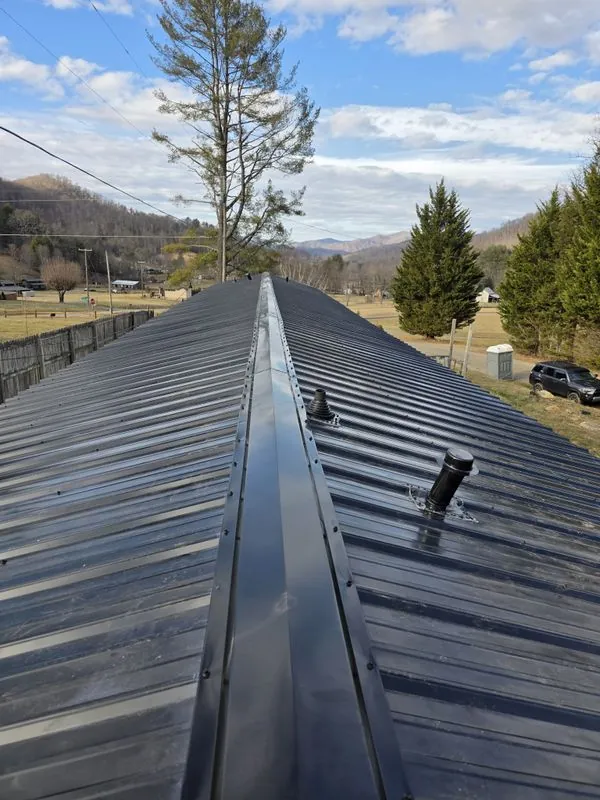
Standing-seam panels run from the ridge to the eave in one continuous length, with the edges of neighboring panels folded or snapped together into a raised seam. The clips that hold the panels to the deck are hidden under that seam, so there is no screw head anywhere on the weather surface. The panels can expand and contract with the temperature swings we get between a January night and an August afternoon without working a fastener loose. It is the cleaner-looking of the two systems and the one in most of our own photos. It costs more, and it is what we recommend for a primary residence you plan to keep.
Exposed-fastener metal
Exposed-fastener panels, often called ribbed or corrugated, overlap at the edges and are screwed straight through the panel into the deck or purlins, with a rubber washer under each screw head. The panels are less expensive and go on faster. The trade-off is that every washer is a point that ages in the sun, so an exposed-fastener roof needs its screws checked and, eventually, replaced. It is a sensible choice for a barn, a workshop, a porch roof, a detached garage or a budget-conscious cabin. We install both and tell you which one makes sense for the building in front of us.
Why metal suits mountain roofs
Snow and needles slide off
On a shingle roof under a stand of white pine or hemlock, needles pile up in the valleys and behind the chimney, hold moisture against the shingle and feed moss. On a smooth metal panel they slide off with the next rain. The same goes for snow on a north-facing slope above Black Mountain or up in Maggie Valley: it releases instead of sitting there through a week of freeze and thaw, which is how ice dams form at the eaves of a shingle roof.
Wind on the ridgelines
A properly clipped standing-seam roof has no individual tabs for the wind to catch and lift. For a house that sits on an exposed ridge in Fairview or along the Blue Ridge Parkway corridor, that is the difference between a roof you think about after every storm and one you do not.
Service life
A metal roof costs more up front than an architectural shingle roof. It also outlasts one by a wide margin, and it holds its appearance through weather that fades and curls shingle. For a homeowner who intends to stay, or for a cabin owner who does not want to manage a second re-roof from a distance, the longer service life is usually what decides it. We put the numbers side by side so the comparison is a real one.
Getting the deck ready
The panel is only as good as what is underneath it. On a replacement we strip the roof to the deck, replace any soft or delaminated sheathing, and lay a synthetic underlayment across the whole surface before a single panel goes up. A high-temperature underlayment matters under metal because the panels run hotter than shingle in direct sun. At the ridge, valleys and eaves we detail the underlayment and the trim so that water, and the condensation that can form under metal on a cold morning, has a clear path out. Flashing at chimneys, skylights and wall junctions is cut and fitted for the specific roof, not pulled from a bin.
Colors and panel profiles
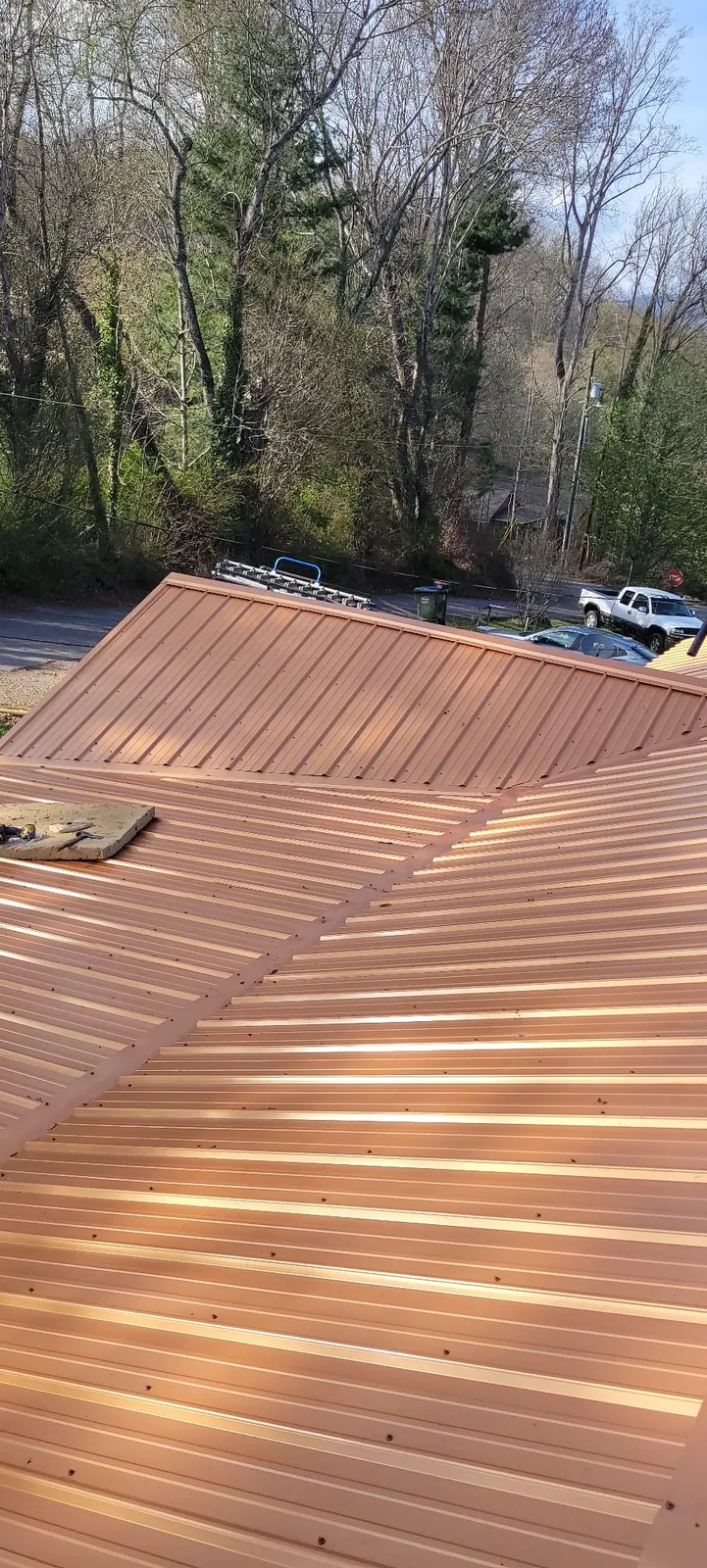
Metal comes in a wide range of factory-finished colors, from the charcoal, black and dark bronze that suit the newer homes toward Arden and Mills River to the barn reds, greens and copper tones that sit well on a cabin in the woods. Lighter colors reflect more heat in summer. Panel width, seam height and rib pattern all change how the roof reads from the street, and some profiles are better suited to a low-pitch section than others. We bring samples to the house rather than asking you to choose from a screen, because a color looks different against your siding and your trees than it does under shop lights.
Metal over existing shingle
Homeowners ask this on nearly every metal estimate. Installing metal over one layer of existing shingle is sometimes allowed and is sometimes a bad idea, and the honest answer depends on the roof. Current North Carolina residential code limits how many layers a roof can carry. Beyond the code, the question is whether the existing roof is flat and dry enough to build on. If the decking under the old shingle is soft, if there are already two layers, or if the roof has a history of leaks, the shingle comes off. If the roof is a single sound layer, a metal-over installation can save tear-off cost and a day of noise. We check the deck from the attic, say which case you are in, and price it accordingly.
Why homeowners choose Arolite Group for metal
- We install shingle too. You get a price for both on your own roof and a straight recommendation, not a pitch for the material we happen to sell.
- Inspection first, free. An exterior consultant checks the deck, the pitch and the flashing before quoting, so the written price is for the roof you actually have.
- In person, in writing. The estimate is itemized and walked through at your kitchen table.
- Local crew, local roofs. We work in Buncombe, Haywood and Henderson counties from our office on Church Street in Asheville.
- Financing available. The higher up-front cost of metal can be spread out over monthly payments. Ask the exterior consultant at the estimate.