
Siding takes more weather in Western North Carolina than most people give it credit for. Wind-driven rain on the exposed side of a ridgeline house, sun on a south wall all summer, freeze and thaw at elevation through the winter, and the constant damp under tree cover all work on it. Old wood siding on the in-town houses around Montford, West Asheville and Waynesville rots at the bottom courses. Older vinyl fades, cracks and lets go at the laps. Behind either one, if the wall was never wrapped, water has been finding its way into the sheathing for years.
Arolite Group installs and repairs siding for homeowners in Buncombe, Haywood and Henderson counties, Western North Carolina and Upstate South Carolina. We focus on roofing, siding and gutters, which means the same company that understands how water moves off your roof is the one wrapping the wall below it. An exterior consultant inspects the exterior, explains what is sound and what is not, and gives you an itemized written price in person.
This page covers the two siding materials we install most, why house wrap is the part of the job you never see and should care about most, the trim and fascia that finish it, how we decide between repairing a section and residing the house, and why doing the roof, siding and gutters as one job is often the cheapest way to get all three done well.
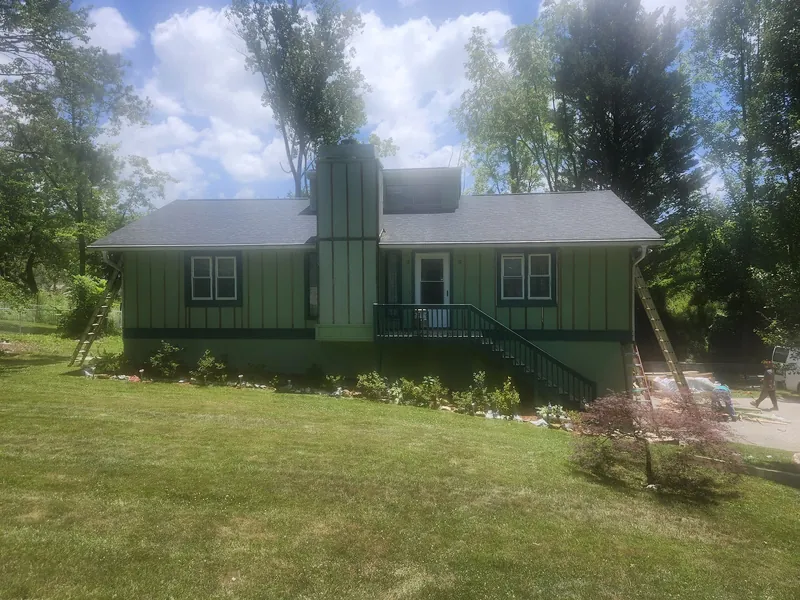
Vinyl and fiber‑cement siding
Vinyl siding
Vinyl is the most common siding in the region for a reason. It is the most affordable option, it never needs painting, it comes in a wide range of colors and profiles, and a modern vinyl panel is thicker and holds its color far better than what went on houses twenty years ago. It is a good fit for a rental, a cabin that is not lived in full time, or any homeowner who wants the exterior handled and does not want to think about it again. The quality of a vinyl job is almost entirely in the installation: a panel nailed tight cannot move with the temperature and will buckle; one hung loose on a proper nail hem will last.
Fiber-cement siding
Fiber-cement is a cement, sand and cellulose board that is cut and hung like wood lap siding and painted. It does not rot, insects do not eat it, and it does not burn the way wood does, which matters on a wooded lot. It takes paint well and holds a crisp shadow line, so it suits the craftsman and farmhouse styles around Asheville and the newer homes toward Fletcher and Mills River. It is heavier and costs more to install than vinyl, and it needs repainting on a long cycle. We walk you through both on the same estimate so the choice is yours with the real numbers in front of you.
House wrap, the part you never see
Siding sheds most of the water that hits it, not all of it. The layer that actually keeps the wall dry is the weather-resistant barrier under the siding, taped at the seams and lapped so that anything that gets behind the siding runs down and out rather than into the sheathing. On every reside we strip to the sheathing, replace any that is soft, wrap the whole wall, and flash every window and door opening so water is directed out over the wrap, not behind it. The photo at the top of this page shows exactly that stage on a two-story home. It is the stage a low-bid crew skips, and it is the difference between siding that looks fine for fifteen years and a wall that is quietly rotting behind it.
Trim, fascia and soffit
Corners, window and door surrounds, frieze boards, fascia at the roofline and soffit under the eaves finish the job and take the worst of the weather. We replace rotten wood fascia and soffit, often found behind a gutter that has been overflowing for years, and finish the trim in a material that matches the siding so the house reads as one piece. Where the roof meets a wall, step flashing and kick-out flashing are set so the roof run-off goes into the gutter instead of down the siding.
Repair or full replacement
When a repair makes sense
A section damaged by a fallen limb, a few rotted boards at a corner, loose panels on one wall after a wind storm, a stretch of fascia behind a failed gutter. If the rest of the siding is sound and we can match it, we repair that section and leave the rest alone. We say so when that is the right answer.
When residing is the better buy
When the siding is failing on more than one wall, when there is no house wrap behind it, when the color has faded unevenly so a patch would be obvious, or when the old wood is rotten at the bottom of most courses, repairs become a yearly expense that never ends. We put the cost of a full reside beside the repair so you can make that call with the numbers in hand.
Roof, siding and gutters as one job
The exterior of a house is one system. The roof sheds water into the gutters, the gutters carry it past the siding, and the siding and wrap handle what blows in sideways. When one piece is being replaced, the others are easier and cheaper to do at the same time: the ladders and scaffolding are already up, the fascia is exposed when the old roof and gutters come off, and the flashing where roof meets wall can be done right once instead of being worked around twice. Homeowners who hire us for all three get one crew, one schedule, one point of contact, and daily updates from the same person throughout.
Why homeowners choose Arolite Group for siding
- Exterior specialists. Roofing, siding and gutters are the whole business, so the crew wrapping your walls is the one that knows where the water comes from.
- Wrap and flash every time. House wrap on every reside, and every window and door opening flashed, not just the walls you can see from the street.
- Written price, in person. An itemized estimate walked through at your table, with both materials priced if you are choosing between them.
- Daily cleanup and daily updates. The things our customers mention in their reviews most often, and the things we hold the crew to.
- Local across three counties. Based on Church Street in Asheville, working in Buncombe, Haywood and Henderson counties, with financing available.