
Most roof problems in the mountains do not need a new roof. They need one thing found and fixed properly: the flashing that was never sealed around the chimney, the pipe boot that cracked after ten summers, the shingles a ridgeline gust lifted last week, the valley that has been catching oak leaves since the house was built. Arolite Group repairs roofs across Buncombe, Haywood and Henderson counties, and a good share of our week is exactly this kind of work.
The hard part of a roof repair is not the repair. It is finding where the water is actually getting in, because a stain on the ceiling is rarely under the hole in the roof. Water runs along rafters, underlayment and wiring before it drops, and the leak you can see in the dining room can start fifteen feet uphill at a skylight. That is why we get on the roof and into the attic before we touch anything, and why the free inspection comes with photos of what we found, not just a price.
We are also the company that will tell you when a repair is throwing good money after bad. A roof that is bald, curling and leaking in three places does not need a fourth patch. If that is what we find, we say so, price the replacement honestly, and let you decide. If the roof has years left, we fix the one thing wrong with it and leave.
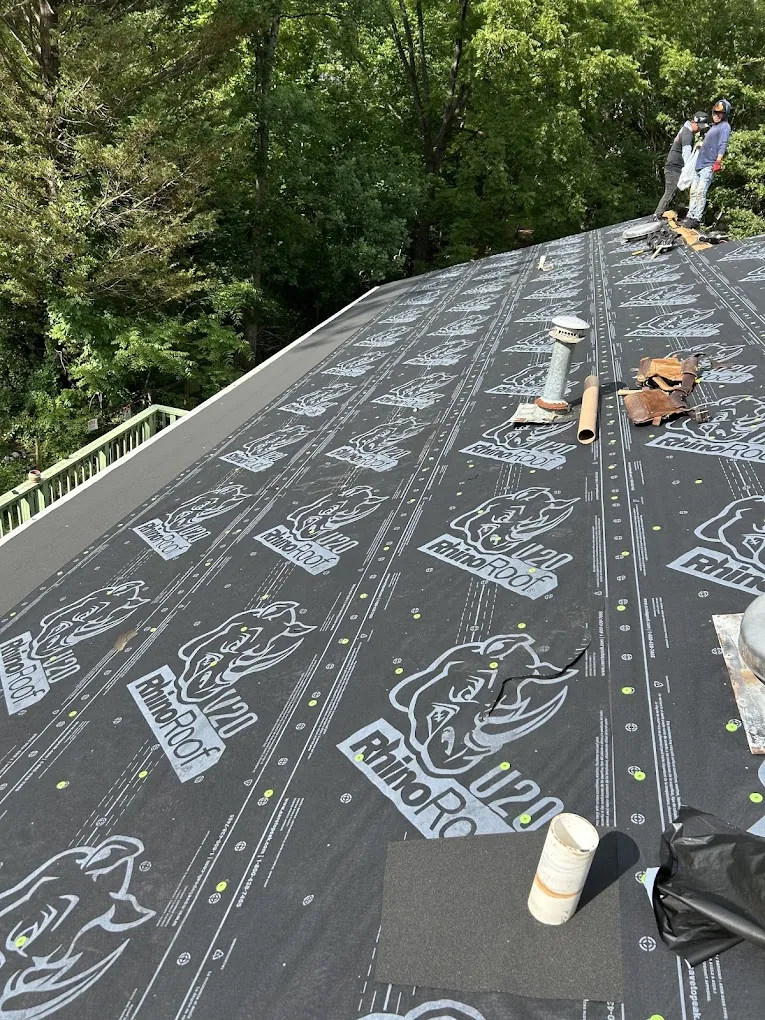
Repairs we do most often
Leak repair
A stain spreading on the ceiling, a drip during a hard rain, a musty smell in the attic. We trace the water back to its source, which on most houses here is a flashing, a penetration or a valley rather than the shingles themselves, and fix the source. A leak that only shows up in sideways rain or in a thaw after a cold snap usually points to the eaves or a north-facing slope where ice has been pushing water uphill.
Missing or lifted shingles after wind
The gusts that come over the ridges above Black Mountain and down the valleys around Waynesville will lift the shingles on a roof where the seal strip has let go, and once one is up, the next one is exposed. We replace the missing and creased shingles, check the surrounding courses for broken seals, and re-nail and hand-seal where the wind has been working. If the storm did more than that, the storm damage and insurance page covers how to handle it as a claim.
Flashing at chimneys, walls and skylights
Flashing is where most roofs in the older neighborhoods of Asheville and Hendersonville actually leak. Brick chimneys with mortar-only counter flashing, sidewall step flashing that was caulked instead of woven into the shingles, skylight curbs sealed with a tube of roofing cement. We replace it with new step and counter flashing, cut into the mortar joint where there is a chimney, and add a cricket on the uphill side of a wide chimney so water and leaves are diverted instead of trapped.
Pipe boots and vents
The rubber collar on a plumbing vent boot lasts about ten years in the mountain sun, then cracks and leaks straight down the pipe into a bathroom wall. It is a small part and a common leak. We replace boots, reseal and re-flash attic vents, and check the ridge vent while we are up there.
Valley repairs
Valleys carry more water than any other part of the roof, and under a heavy tree canopy they also carry pine needles and leaves that hold moisture against the shingles for months. A valley that has worn through, or was never lined with ice-and-water membrane, gets opened up, re-lined and re-shingled or fitted with metal valley flashing, depending on the roof.
Tree-limb and impact damage
A limb through the roof needs two visits: one to tarp and make the house watertight, one to repair it properly once you and your insurer have the photos. We cut out the damaged decking, sheet it, dry it in and re-shingle so the patch matches the rest of the roof as closely as the shingle color allows.
When a repair is honest money, and when it is not
A repair is the right call when the problem is in one place and the rest of the roof is sound: the shingles still hold their granules, the decking is dry when we walk it, and the leak has one clear cause. Fixed properly, a repair like that buys years, and it should cost a fraction of a replacement. A repair stops being honest money when we are being asked to patch the third leak on a roof whose shingles are bald, when the decking is spongy across a slope, or when the repair would cost a meaningful share of a new roof that is going to be needed within a couple of years anyway. We see both every week, and the inspection write-up says which one you have, in plain language, with the photos to back it up.
How a repair runs
Call or send the form and describe what you are seeing. An exterior consultant comes out, gets on the roof and into the attic if the leak calls for it, and photographs the problem. You get a written price in person for the repair, and if the roof is near the end of its life, a second price for the replacement alongside it so you can compare. Most repairs are done in a single visit, and the yard is picked up before we leave. If the roof is actively leaking into the house, say so when you call and we will get it tarped first and quoted second.
Why homeowners here call Arolite for a repair
- We find the source, not just the stain. Roof and attic both get checked, and the photos of what we found come with the quote.
- No upsell to a roof you do not need. If a repair buys the roof years, that is what we recommend, in writing.
- Repairs to a new-roof standard. The flashing and valley work on a repair is done to the same standard as a new roof, by people who do that work every week.
- Local and reachable. Based on Church Street in downtown Asheville, Monday to Saturday, 8:00 AM to 6:00 PM, at (828) 818-8392.