
Most roof problems in the mountains start small and stay hidden. A cracked pipe boot on the back slope, a lifted shingle on the windward side of the ridge, a valley packed with oak leaves and pine needles from last fall, a soft spot in the decking that you cannot see from the yard. By the time any of it shows up as a stain on the bedroom ceiling, the repair is bigger than it needed to be. An inspection catches it while it is still a small fix.
Arolite Group offers free roof inspections to homeowners in Buncombe, Haywood and Henderson counties, Western North Carolina and Upstate South Carolina. An exterior consultant comes to the house, gets on the roof when it is safe, checks the attic, and goes over the gutters and the drip edge. You get photographs of what we found and a written set of findings. If the roof is fine, we say so and leave. If something needs attention, we explain what and why, and you get an itemized written price for the work if you want one. That is the whole process.
We started in Asheville and we work here. The office is on Church Street downtown, and we serve Western North Carolina and Upstate South Carolina, from West Asheville and Montford out to Black Mountain, Weaverville, Candler, Waynesville and Hendersonville. This page explains what the inspection covers, what you receive, when it makes sense to book one, and what it is not.
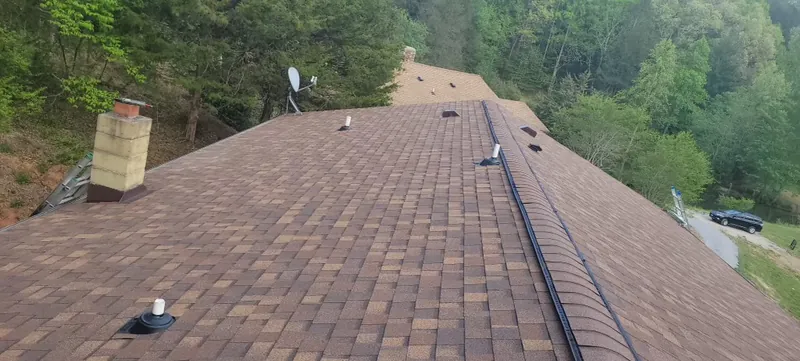
What gets checked
Shingles or panels
On a shingle roof we look for cracking, curling, missing tabs, granule loss that shows up as bare asphalt or as grit in the gutters, and hail bruising. On a metal roof we check seams, fastener heads and washers, and any panel dents. We note the age and condition of the roof overall so you know roughly where it is in its life.
Flashing and boots
Chimney flashing, step flashing along walls and dormers, and the rubber boots around plumbing vents fail long before the roof around them does. They are the most common source of a leak on an otherwise sound roof in the older in-town stock around Asheville and Waynesville, and the cheapest thing to fix when caught early.
Valleys and ridges
Valleys carry the most water on the roof and collect the most debris under tree cover. We clear enough to see the valley metal or the shingle weave and check it for wear. At the ridge we look at the cap shingles and the ridge vent for lifting and for gaps the wind can get under.
Decking, from the attic
Soft decking does not announce itself from above. We go into the attic with a flashlight and look for daylight, water staining on the underside of the sheathing, dark streaks along the rafters, damp insulation and signs of mold. This is also where we can see whether a previous leak was ever actually fixed or just painted over.
Gutters, drip edge and fascia
Gutters that are pulling away, sagging, or packed solid tell us water has been running behind them, and that shows up as rotten fascia and soffit. We check the drip edge where the roof meets the gutter, because a missing or short drip edge lets water wick back under the shingle on a hillside lot.
Ventilation
Intake at the soffits and exhaust at the ridge keep the attic close to outside temperature. Poor ventilation cooks shingle from underneath in summer and feeds the ice dams that form on north-facing slopes at elevation in winter. We note whether the roof is breathing properly and what it would take to correct it.
What you receive
Before the exterior consultant leaves you get a plain-language summary of what we found, and afterward you receive the photographs and written findings. If there is nothing wrong, the write-up says so. If there is, it lists each item, what it means for the roof, and whether it is urgent, worth doing this year, or worth watching. Should you want work done, the exterior consultant sits down with you in person and goes through an itemized written price. You keep the photos and the findings either way. Homeowners use them for insurance claims, for a real estate negotiation, or simply as a record of the roof for the next time they want it looked at.
When to book an inspection
After a storm
High wind on a ridgeline, hail, or a hurricane remnant like Helene in September 2024 can damage a roof without leaving anything on the lawn. Getting the roof documented soon after the weather gives you a dated record before any insurance conversation. See our storm damage and insurance page for what to do in the first day.
Before you buy or sell
A general home inspector looks at the roof from a ladder or the ground. A roofer gets on it. If you are buying a house in Haywood or Henderson County and the roof is the one thing you cannot afford to be wrong about, an inspection before closing is worth the hour. If you are selling, a written finding that the roof is sound removes an objection before it is raised.
A roof over fifteen years old
Architectural shingle in our climate, with its sun, ice and tree debris, is well into the second half of its life by fifteen years. A yearly look from that point on turns a surprise replacement into a planned one.
After a tree comes down
Even when the trunk misses the house, a limb that glanced off the roof can crack decking and split shingle in a way that does not leak until the next hard rain. If anything hit the roof, have it looked at.
What the inspection is not
It is not a sales appointment. We are a roofing company and we would like your business if the roof needs work, but the exterior consultant who comes out is there to give you a straight answer, not to find a reason to replace a roof that has years left in it. Reviews of our work describe exactly that: to the point, direct, honest, no pressure. If the roof is sound, you will hear that, and the free inspection costs you nothing but the time it took to book it.
Why homeowners book with Arolite Group
- Free, and yours to keep. Photos and written findings, no charge, whether or not you hire us.
- On the roof and in the attic. We check from both sides, which is the only way to confirm the decking.
- A straight answer. Sound roofs get told they are sound. Problems get explained in plain language with a photo of each one.
- Roof, siding and gutters in one visit. If the fascia or the siding needs attention too, the same exterior consultant sees it and the same company can handle it.
- Local since the start. Based in downtown Asheville, working across Buncombe, Haywood and Henderson counties, Monday to Saturday.